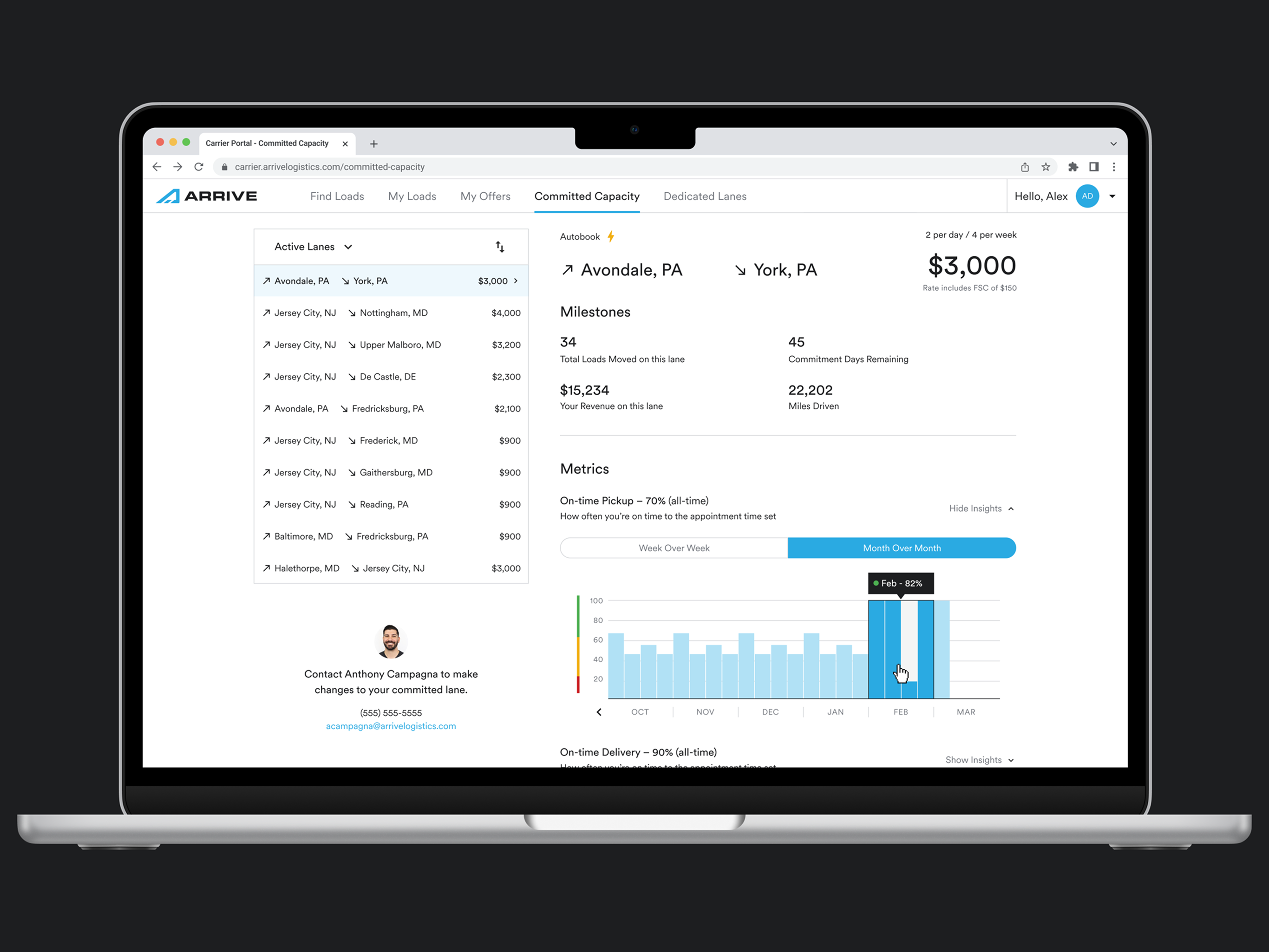
Recurring Freight Visibility
Self-service booking worked well for individual loads, but some carrier relationships were built around something more predictable: recurring lanes and committed freight. Carriers needed a way to understand what they had committed to, what was currently available, and where action was required without rebuilding that context load by load.
The Business Opportunity
Committed Capacity had a measurable reason to scale. Contract loads moved with committed carriers averaged $233 in spread compared with $199 for non-committed carriers, a $34 difference per load. Yet only 1% of contract freight was being moved by committed carriers. The opportunity was to make committed capacity easier to discover, sell, monitor, and ultimately use more often.
I designed the Committed Capacity dashboard to turn those agreements into a manageable digital experience, giving carriers a clear view of active and inactive commitments, lane details, and the state of each opportunity.
My Role
As the product designer embedded with the Carrier team, I owned the carrier-facing experience and worked with product, engineering, carrier sales, and operations to translate the business rules behind committed freight into understandable interface states and workflows.